Thinking About a Career in Demand Planning? Read This First.
I've spent 5+ years working across Demand Planning, Forecasting, and S&OP roles, and in February 2026 I reviewed what employers consistently expect from entry-level candidates. Below, I'll walk you through these expectations — and help you understand if Demand Planning is the right path for you.
What Demand Planning Actually Is
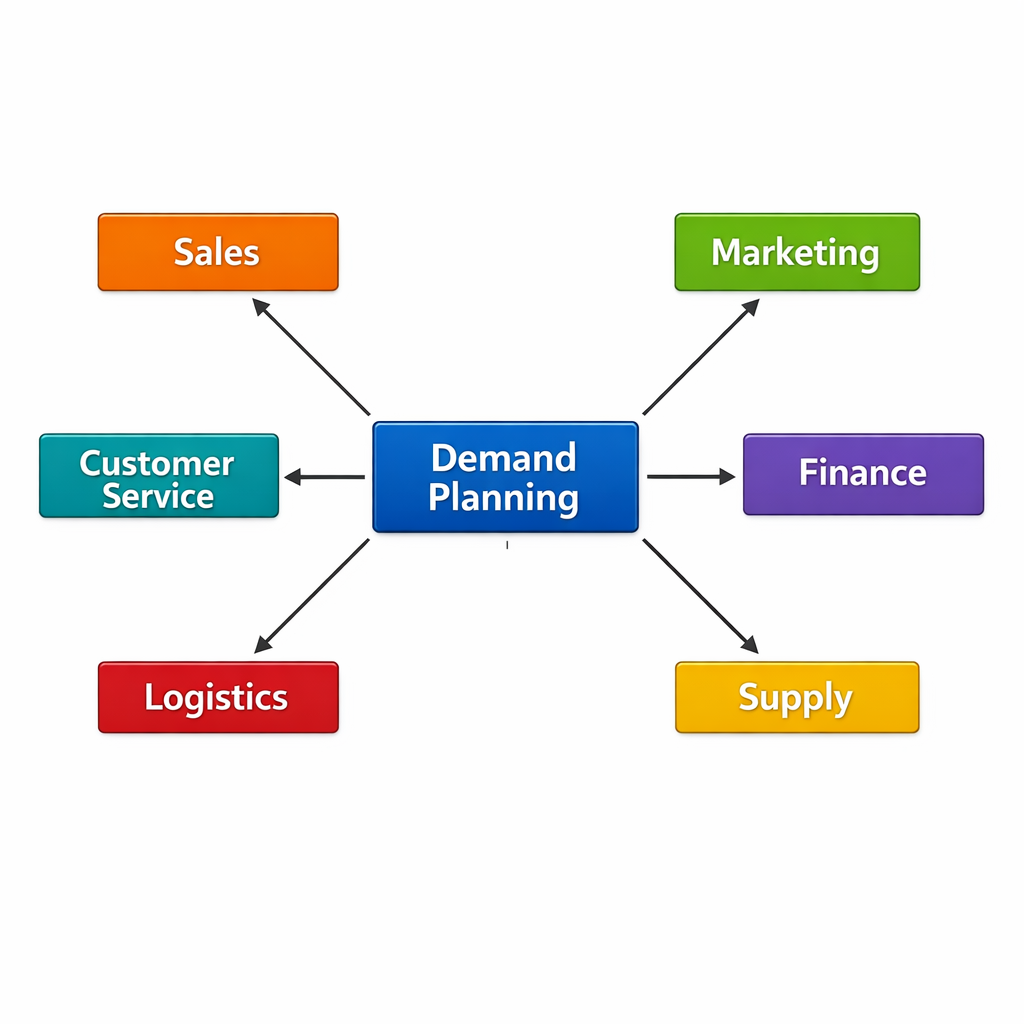
Demand Planning sits at a unique intersection of the organization. Think of it as the bridge between the commercial side (Sales, Marketing, Finance) and the operational side (Supply Planning, Production, Logistics).
Your role is simple in theory but challenging in practice: understand what customers will buy, communicate that understanding, and translate it into actionable numbers.
Demand Planners don't produce products. They don't set prices. They don't run campaigns. But they ensure the entire company is working with a single, realistic view of future demand. If you do your job well, companies avoid stockouts, reduce waste, stabilize production, and make much better decisions.
This is why the role is so cross-functional — and why people skills matter as much as technical ones.
Thinking if a Job in Demand Planning is a Good Idea for You?
When you should consider Demand Planning:
- Enjoy working with data and finding patterns
- Like solving problems and asking "why?"
- Feel comfortable with ambiguity
- Enjoy interacting with different teams
- Prefer structured work but still want room for interpretation
- Want a job that gives broad business exposure early in your career
It may not be the right fit if you:
- Dislike analytical work or numbers
- Prefer fully predictable tasks
- Avoid discussions or conflict
- Have difficulty summarizing information clearly
- Don't want to work with Excel, data tools, or systems
- Dislike being accountable for outcomes
The truth is: Demand Planning attracts people who enjoy clarity and logic — but are also comfortable navigating uncertainty. If that balance appeals to you, you'll likely thrive. I saw people who were "tech nerds" — awesome in data, terrible working with people. It wasn't a good idea for them to continue in DP. I also saw a brilliant communicator who was scared of Excel. It was awesome to talk to that person but horror to work with them. Demand Planning is about balance between those two extremes.
Key Requirements for Starting a Career in Demand Planning (2026 Analysis)
Below are the competencies employers consistently list for entry-level roles — and why they matter.
1. Analytical Skills & Basic Statistical Understanding
Demand Planning is fundamentally about working with data. You don't need to be a data scientist, but you must understand: trends, seasonality, basic forecasting logic, calculations and data analysis, and how to form conclusions from numbers.
You'll spend a big part of your week reconciling different data sources, challenging assumptions, and explaining numerical outcomes. The stronger your analytical thinking, the faster you'll grow.
2. Excel & Data Visualization
This may feel basic, but Excel remains the backbone of most demand teams — even in global corporations with advanced tools.
To start you need to know: pivot tables, VLOOKUP/XLOOKUP, basic formulas, conditional formatting, chart creation, and how to structure data properly.
It is nice to prove your skills with a certificate or a personal project. If you have no commercial experience, build something for yourself — a budgeting tool, semi-automated dashboard, shopping price tracker — that's enough to show that you know how to organize and structure data well.
Data visualization tools like Power BI or Tableau are a plus — not a must — but you should understand the concept of dashboards.
3. KPIs: Understanding, Measuring, and Interpreting
Measuring KPI values is in general easy. Interpreting them is what Demand Planners get hired for.
Expect to work with KPIs such as: forecast accuracy, bias, service level, inventory days, obsolescence.
Your value isn't in reporting numbers but in explaining:
- Why the Forecast Accuracy of only one brand goes down
- What root cause created the Out Of Stock event
- What action should follow an increase in customer orders
This is where logical thinking truly matters.
4. Planning Software
Getting hands-on experience before your first job is nearly impossible — but that's okay. What you can actually do is:
- Learn the names of top tools. For now I would say — SAP IBP, Kinaxis, o9, Blue Yonder
- Understand what these systems do — the most common views, operations, functions
- Watch demos, read documentation, or take free micro-courses — there are plenty on YouTube and other streaming platforms
Knowing the ecosystem shows that you're proactive and understand modern planning processes. Bonus points for you!
5. Cross-Functional Collaboration
Demand Planners interact constantly with Sales, Marketing, Finance, Supply Planning, and Customer Service.
People will ask you questions, challenge your numbers, and rely on your conclusions. That means you must show: friendly, open communication; the ability to explain numbers clearly; confidence in discussions; and willingness to listen and find alignment.
It's not a "sit quietly and forecast alone" type of job — communication is half the role. You also have to be prepared for:
- working under pressure (especially when the DMR is just around the corner and slides are still not ready!),
- dealing with people's emotions (to answer questions like What? I don't care that leadtime is 4 weeks, I need product NOW),
- staying calm (your miss-click can trigger production worth millions of EUR).
6. English (Especially Corporate English)
If you plan to work in a global corporation, strong spoken English is non-negotiable. You will have to talk in English, write and read mails, and even work in software that will probably be in English.
OK, maybe we live in an era of LLMs where AI can help you write emails, but…
- It cannot replace you during a meeting
- It cannot negotiate alignment
- It cannot represent your viewpoint
- It cannot clarify misunderstandings
Focus on: business vocabulary, meeting language, common terms in planning and supply chain, abbreviations (SKU, S&OP, MOQ, etc.).
The more confident you are, the easier the job becomes.
7. Degree
Most companies still require a degree, usually in areas like Business, Economics, Engineering, Mathematics, or Supply Chain.
However, from my experience, your skills matter more than your diploma. A motivated candidate with strong Excel skills and analytical potential often stands out more than someone with a "perfect" degree but no initiative.
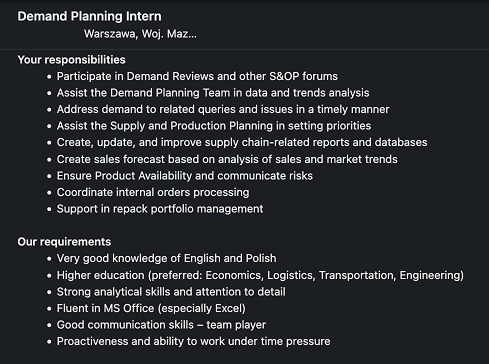
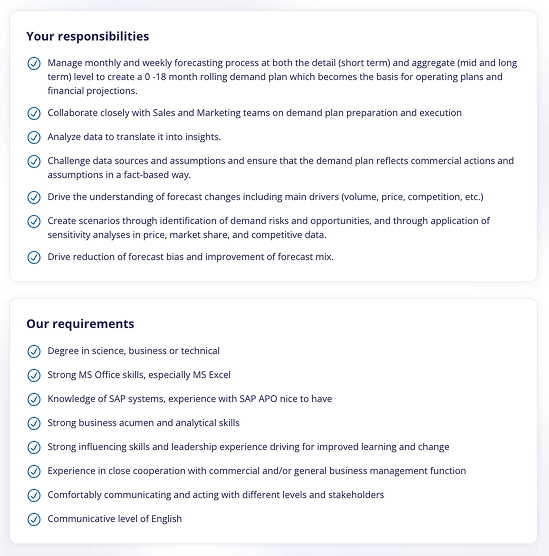
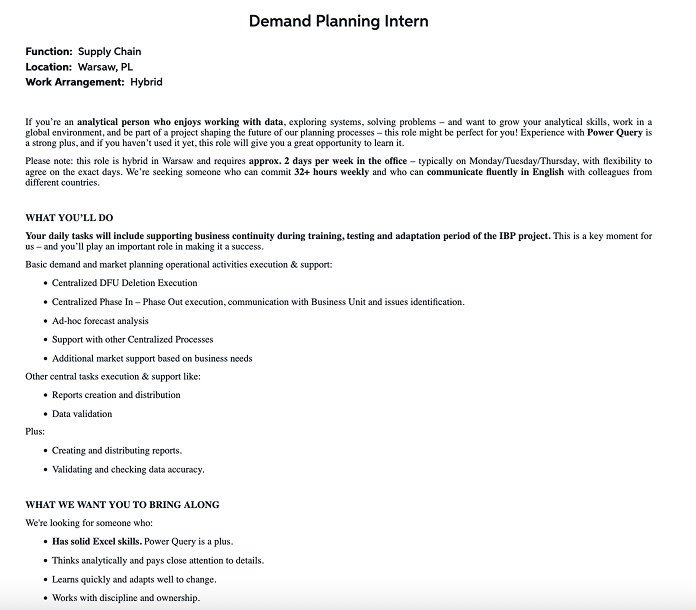
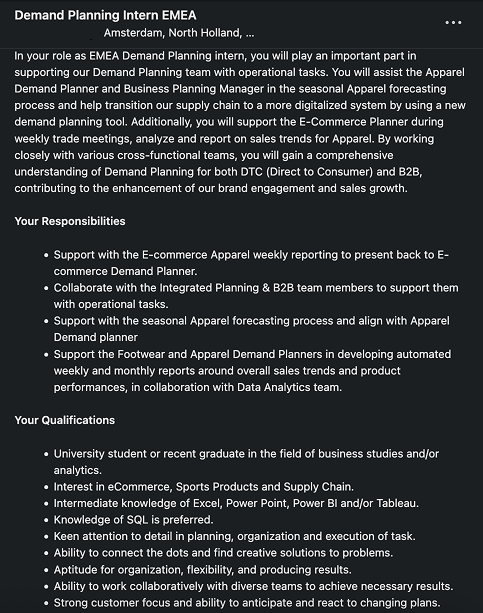
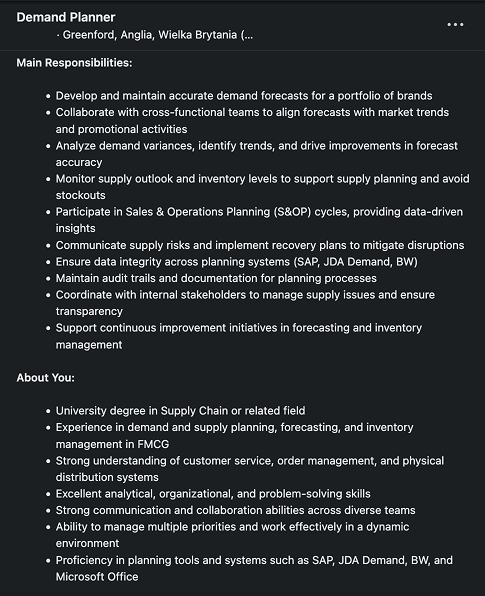
Some examples of entry-level job offers:
Final Thoughts
Demand Planning is an excellent career entry point if you want a strong understanding of how large companies operate. You'll work with data, processes, people, and systems — all at once. It gives you visibility, responsibility, and a wide set of transferable skills.
But it also requires curiosity, discipline, communication skills, and a willingness to challenge the status quo.
If those qualities resonate with you, then Demand Planning might be the career door that changes everything.